Chorten Kora Tshechu Festival Tour 2026 | 14 Days Eastern Bhutan with Truly Bhutan Travel
Trip Summary
- Trip Grade: Easy to Moderate
- Duration: 14 Days, 13 Nights
- Activity: Cultural Festival Tour
- Route: Paro, Thimphu, Phobjikha, Trongsa, Bumthang, Mongar, Trashiyangtse, Mongar, Bumthang, Paro
- Departure Point: Paro International Airport
- Return Point: Paro International Airport
- Trip Cost From: $6809 per person (SDF+Visa Fee inclusive)
- Festival Dates: Dakpa Kora, 20 February 2027
- Last Updated: March 2026
About the Chorten Kora Tshechu Festival Tour
A 14-day private guided tour from Paro to eastern Bhutan and back, centered on the Chorten Kora Tshechu festival at Trashiyangtse, passing through Phobjikha, Trongsa, and Bumthang on both legs.
The Chorten Kora Tshechu Festival Tour covers 14 days across four regions of Bhutan, built around one of the most singular pilgrimage festivals in the eastern Himalayas. Truly Bhutan Travel designs this tour for travelers who want both the full arc of Bhutan’s cultural interior and a direct encounter with the Dakpa Kora tradition at Chorten Kora. The 2027 festival falls on March 3rd at Chorten Kora in Trashiyangtse, at 1,750 meters beside the Kholung Chhu River.
Experience Snapshot
I have attended the Chorten Kora Tshechu at first light, before the main circumambulation begins, when Dakpa families from Tawang are still arriving and the butter lamps inside the stupa are the only light in the courtyard. Some of these pilgrims walked three days through forested mountain terrain to reach this stupa. The sound of the Kholung Chhu river below and the low murmur of prayers in the cold March air stays with you long after you leave Trashiyangtse.
What Is the Chorten Kora Tshechu Festival?
The Chorten Kora Tshechu is the most widely attended annual festival in eastern Bhutan. The festival centers on kora, the act of circumambulating a sacred stupa to earn spiritual merit. Two separate circumambulation events take place at Chorten Kora each year, separated by approximately two weeks. The first, Dakpa Kora, is held on the 15th day of the first Bhutanese lunar month. The second, Drukpa Kora, is held on the 30th day of the same month.
Dakpa Kora draws hundreds of pilgrims from the Dakpa community of the Tawang District in Arunachal Pradesh, India. Drukpa Kora draws Bhutanese from Trashiyangtse, Trashigang, and Kurtoe. Both festivals honor a legend of a young Dakini princess from Tawang who agreed to be entombed alive inside the stupa as an act of devotion. A Dzongkha language film based on this story was made in Bhutan. The festival is a tribute to her sacrifice, and Dakpa pilgrims have traveled to Chorten Kora for over a millennium to honor her.
What Is Chorten Kora and Where Is It Located?
Chorten Kora stands on the Kholung Chhu riverbank in Trashiyangtse, Bhutan’s easternmost district. The stupa sits at 1,750 meters, three minutes from Trashiyangtse town and two hours by road from Trashigang. Lama Ngawang Loday built Chorten Kora in 1740 over a period of 12 years. He modelled the structure directly on the Boudhanath stupa in Nepal, with the intention that pilgrims in eastern Bhutan would earn equivalent merit without traveling to Nepal. The 13th chief abbot of Bhutan, Je Sherab Wangchuk, consecrated the stupa. Chorten Kora is now considered one of the most significant historical Buddhist structures in eastern Bhutan.
When Is the Chorten Kora Tshechu in 2027?
The 2027 Dakpa Kora falls on February 20th. Festival dates shift annually following the Bhutanese lunar calendar. Truly Bhutan Travel confirms all dates before finalising your booking. Contact us to verify 2027 Drukpa Kora dates and secure your place.


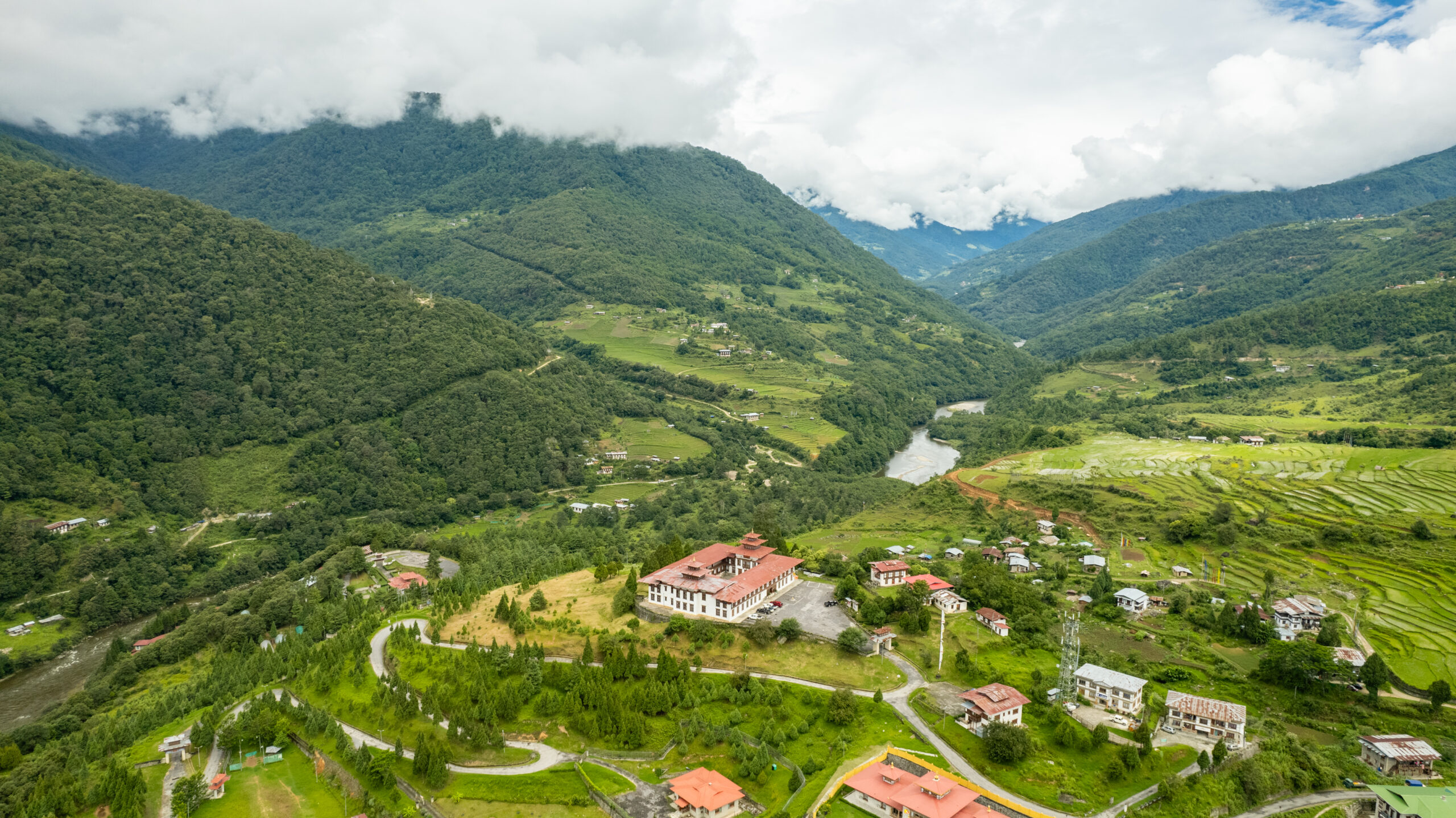
On arrival in Paro, you will be met by our representative and transferred to your hotel in Thimphu, the Capital of Bhutan for two nights. Spend rest of the day at leisure to allow for acclimatization.
Today you’ll explore a fascinating full day tour to see the best of Thimphu city at an altitude of 2,350 m. First stop is at the National Memorial Chorten, built in memory of the third King Jigme Dorji Wangchuk. Next, visit the Changangkha Monastery, the Folk Heritage Museum, a showcase of the Bhutanese artifacts used in rural households, the National Library, which houses ancient manuscripts or the Painting School. This afternoon, head out of town to explore the Simtokha Dzong, which is the oldest fortress in Bhutan, built in 1629 or visit the National Textile Museum. Overnight in Thimphu.
After breakfast, today we travel to Gangtey via Wangdue Phodrang for a distance of 135-km for about 5-6 hours journey and en route stop at Dochula pass at an altitude of 3,050 m. If weather is clear, you will enjoy a breathtaking view of the snow capped eastern Himalaya ranges and also a magnificent distant view of the Gasa Dzong from this spot. After lunch, visit the Wangdue Phodrang Dzong. Continue on the journey to Gangtey in Phobjikha, which is one of the winter roosting grounds of the rare Black-necked Cranes, where they come in hundreds after spending their summer in Tibet and then migrate to the Himalayas of Bhutan to spend their winter – they arrive in the months of September and October and fly back to Tibet between February and March. Along the highway, you’ll photo stops as there are loads of breathtaking views during the journey. Overnight in Gangtey.
The altitude of Gangtey in Phobjikha valley is 3,000 m. This morning you will visit the picturesque Gangtey Gompa (monastery). Enjoy the views of the remote Phobjikha glacial valley and the black mountain ranges. After lunch we travel a distance of 120-km for about 5 hours to Trongsa via Pelela pass at an altitude of 3,300 m. This pass is an important dividing range that separates western from central and eastern Bhutan. En route stop at Chendebji Chorten (stupa) located just below the road. Spend the night in Trongsa.
Today morning you’ll visit the Trongsa Dzong, the ancestral home of the present Royal Family where the first two kings ruled from this dzong and also visit the Ta Dzong (ancient watch tower). After lunch, you’ll continue the journey for a distance of 68-km for about 2 hours to Bumthang, the most beautiful valley and cultural heartland in the Kingdom. En route we will stop for a quick visit to the Yathra Weaving Factory at Chumey, where they use yak and sheep wools for Yathra products with patterns unique to Bumthang. The evening is at leisure to relax and enjoy, we have allowed some time for this and also to explore the delightful surroundings of Bumthang valley at 2,600 m. Overnight in Bumthang.
After breakfast, we set out for a full day sightseeing to experience more of this spiritual heartland of Bhutan. You will visit the following legendary monasteries, temples and dzong: the Jakar Dzong, the Jambay Lhakhang, built in the 7th century by the King Songtsen Gampo of Tibet, the Kurjey Lhakhang, built in 1652 and named after the body imprint of Guru Rinpoche who introduced the Buddhism in Bhutan and visit the Tamshing Lhakhang, built in 1501 and the most important Nyingma temple in Bhutan. If time permits, visit the famous Swiss Cheese Factory and Diary Farm in Bumthang. Overnight in Bumthang.
This morning takes you through a scenic journey for a distance of 198-km for about 7-8 hours journey to Mongar at an altitude of 1,600 m. Along the journey you will cross the two villages called Ura and Sengor passing through the highest point on Bhutan’s lateral road via Thrumshingla pass at an altitude of 3,800 m. En route stop at Ura Shelthangla, where you will enjoy a magnificent view of the Bhutan’s highest peak, Mt Gangkar Puensum at 7,500 m. Next, stop at Sengor village and Namling where you can view the breathtaking landscapes of the cascading waterfalls and admire the diverse flora and fauna in these places. Descending down the road will take you to Lingmethang at an altitude of 700 m and cross the Kurichu River, where the largest hydroelectric power in the eastern region is commissioned over the river. Spend the night in Mongar.
After breakfast, we depart Mongar after a quick visit to the Mongar Dzong and head to Trashiyangtse for a distance of 146 km for about 5 hours journey via Korila pass at an altitude of 2,450 m. Afterwards road descends and passes through the famous turns of Yadi and en route you will see the temple, perched on top of a steep hill above the village which is the most important monastery of eastern Bhutan. This is the place of origin of the famous Drametse Nga Chham, a masked dance with drums. Visit the Trashigang Dzong before having lunch at Trashigang. Continue into Trashiyangtse at altitude of at altitude of 1,850 m, a fairly new district that was separated from Trashigang. You will spend three nights here.
Attend Chorten Kora Festival. The sanctity of the three-day religious festival draws the Dakpa tribe in neighboring Arunachal Pradesh (India) who endures days of travel on foot amid rugged environs with entire families. Some say the Dakpas have done this for more than a millennium; beginning shortly after Guru Padmasambhava sanctified the place in the 8th century. Overnight in Trashiyangtse.
This morning you will be taken to visit Bumdeling, a wonderful plain alongside the Kholong chhu River. Bumdeling is also one of the winter roosting grounds of the rare Black-necked Cranes, where they come in hundreds after spending their summer in Tibet and then migrate to the Himalayas of Bhutan to spend their winter – they arrive in the months of September and October and fly back to Tibet between February and March. Back to Trashiyangtse and lunch at your hotel. Later visit the new Trashiyangtse Dzong. We will also visit the dazzling white Chorten Kora (stupa) on the Kholong chhu riverbank below the town and the Institute for Zorig Chusum, where students are trained in the 13 traditional arts and crafts of Bhutan. Overnight in Trashiyangtse.
Drive to Mongar and Sightseeing at Mongar. Overnight at a hotel in Mongar.
Enjoy the drive to Bumthang and Overnight at Bumthang.
Drive to Bumthang. Overnight at a hotel in Paro
Depart from Paro towards your onward destination.
The 2027 Dakpa Kora falls on February 20th. Both festivals follow the Bhutanese lunar calendar and shift each year. Truly Bhutan Travel confirms all dates before finalizing your booking. Contact us to secure your place for 2027.
Dakpa Kora is held on the 15th day of the first Bhutanese lunar month for the Dakpa community from Tawang District in Arunachal Pradesh, India. Drukpa Kora follows on the 30th day of the same month for the Bhutanese. Both festivals involve circumambulating Chorten Kora to earn spiritual merit. Dakpa Kora is distinguished by the cross-border pilgrimage on foot from India, which some families have performed for over a millennium.
Email us or send a WhatsApp message. Share your travel dates, group size, and any route or accommodation preferences. The team responds within 24 hours with a confirmed quotation. Spring festival tours fill early, so early contact secures your preferred 2027 dates and accommodation across the full 14-day route.
The tour starts from $243 per person per day for a group of 13, inclusive of the $100 per day Sustainable Development Fee. Rates by group size: 2 people travel at $295 per day, 4 at $283, 5 at $273, 9 at $265, 16 at $223, and 19 at $211. All rates are in US dollars and include accommodation, all meals, guide, transport, and SDF across all 14 days.
Yes. An experienced, English-speaking Truly Bhutan Travel guide accompanies you for all 14 days. Bhutan government regulations require all international visitors to travel with a licensed guide. Your guide provides cultural context at every site and during the festival itself, explaining each ritual, the legend of Chorten Kora, and the significance of the Dakpa pilgrimage tradition.
Truly Bhutan Travel requires a deposit to confirm your booking and secure your festival dates. The exact deposit amount is confirmed at the time of quotation based on group size and tour duration. Contact trulybhutan@gmail.com or WhatsApp +975 77111115 to receive complete booking terms and deposit details.
- Airport pick-up and drop-off by private vehicle.
- 3-star accommodation (4 & 5 stars may require an additional premium update).
- Bhutan visa fee – including all necessary processing
- Route Permit
- Three meals per day during your stay in Bhutan
- A licensed Bhutanese tour guide
- All land transportation by private vehicle
- Camping equipment and haulage for trekking tours
- Sightseeing as per itinerary
- Monuments entrance fees where applicable
- Drinking water
- All internal taxes and charges
- A sustainable development fee of $200. (This sustainable development fee goes towards free education, free healthcare, and poverty alleviation, along with the building of infrastructure.)
- Airfare & Travel Insurance
- Expenses of personal nature, Tips to guides and drivers
- Expenses occurred due to unavoidable events i.e. road wrecks, flight delays etc.
Best Time to Attend the Chorten Kora Tshechu
March is one of the clearest months in eastern Bhutan. The winter cold eases from mid-February, and skies stay clear before the pre-monsoon haze builds from late April. Temperatures in Trashiyangtse reach 16 to 20 degrees Celsius during the day and drop to 6 to 10 degrees at night in early March. Thrumshingla Pass at 3,800 meters requires warm layers even in March. Pack for cold morning starts at altitude and warm afternoons at 1,750 meters in Trashiyangtse.
Getting to Trashiyangtse
Paro International Airport receives all international arrivals. Drukair and Bhutan Airlines fly from Bangkok, Kolkata, Delhi, Kathmandu, Singapore, and Mumbai. The overland journey from Paro to Trashiyangtse spans approximately 650 kilometers and takes four staged driving days through Thimphu, Phobjikha, Trongsa, Bumthang, and Mongar. Truly Bhutan Travel coordinates all road transport and accommodation across the full route in both directions.
Altitude and Physical Preparation
This tour crosses four high passes: Dochula at 3,050 meters, Pelela at 3,300 meters, Yutola at 3,400 meters, and Thrumshingla at 3,800 meters. The festival site at Trashiyangtse sits at 1,750 meters. Most travelers adjust well to these altitudes with staged acclimatization built into the itinerary. Drink water consistently from Day 1. Speak with Truly Bhutan Travel before travel if you have any altitude sensitivity.
What to Wear at the Festival
Wear modest, respectful dress for the circumambulation. Long trousers or skirts and covered shoulders are appropriate at Chorten Kora during the festival. Comfortable footwear for uneven ground around the stupa serves well. A daypack for water, a light jacket, and sun protection covers the full day at the festival site.
The Oldest Cross-Border Pilgrimage Tradition in Eastern Bhutan
No other festival in Bhutan draws pilgrims across an international border on foot. The Dakpa community of Tawang in Arunachal Pradesh has traveled to Chorten Kora for centuries, making a multi-day walk through forested terrain, in full traditional dress, to circumambulate a stupa built in 1740 in honor of a girl from their own community. Attending the Chorten Kora Tshechu with Truly Bhutan Travel places you inside this tradition as an observer, with a guide who explains the full depth of what you are witnessing.
What the Full 14-Day Route Delivers
This itinerary does not rush to Trashiyangtse. The staged drive east through Phobjikha, Trongsa, and Bumthang builds the geographic and cultural context for understanding eastern Bhutan. Phobjikha Valley in early March still holds black-necked cranes before their departure to Tibet. Bumthang’s temples date to the 7th century. The Thrumshingla crossing at 3,800 meters is one of the most dramatic passes on any Bhutan itinerary. Truly Bhutan Travel selects accommodation, pacing, and site visits to maintain a luxury experience throughout.
Book Your 2027 Chorten Kora Tshechu Tour
The 2027 Dakpa Kora falls on February 20th. Contact Truly Bhutan Travel at trulybhutan@gmail.com or WhatsApp +975 77111115. The team builds your complete 14-day itinerary, confirms accommodation across the route, and assigns your English-speaking guide. Spring festival dates go first. Contact the team now to secure yours.
Alternative Tours with Truly Bhutan Travel
Bhutan Travel Info
Travel Essentials
- Travel/Medical Insurance: Ensure a worry-free journey with Bhutan's dedicated travel and medical insurance plans offered by the Royal Insurance Corporation of Bhutan. Visit RICB for more information.
- Banking: Modern banking facilities are available in urban areas of Bhutan, with banks like Bank of Bhutan Limited, Druk PNB, and Bhutan National Bank. ATMs are common in Thimphu and Phuentsholing, but scarce in rural areas. Complete your banking in major cities.
- Money Matters: Bhutan's currency is the Ngultrum (Nu), which is equivalent in value to the Indian Rupee. Foreign travelers should bring traveler’s cheques or cash, especially USD. Credit cards like Visa and American Express are accepted in most areas.
- Communication: Bhutan's telecommunications are well-developed with internet cafes, mobile phone coverage, and international roaming available in most towns.
- Electricity: Bhutan operates on 230 volts and 50 Hertz. Ensure your devices are compatible with the three types of plugs commonly used.
- Time Zone: Bhutan's time is six hours ahead of GMT.
Health, Safety, and Customs
- Health and Inoculations: Recommended vaccinations include tetanus, typhoid, and hepatitis A. Avoid untreated water and ice cubes; instead, opt for bottled water, which is readily available.
- Safety Precautions: Bhutan is generally safe, but avoid walking alone or staying out late, especially after 9 PM. Secure your belongings, particularly in the capital, Thimphu.
- Customs Regulations: Personal belongings, 1 liter of alcohol, 200 cigarettes, and professional equipment are exempt from customs duty. Importing restricted items, such as wildlife products, antiques, and drugs, is prohibited.
Accommodation, Food, and Shopping
- Accommodation: Bhutan offers a range of accommodations, from quality 3-star to luxury 5-star hotels in places like Thimphu, Paro, and Punakha. Travelers can also opt for camping when venturing beyond urban areas.
- Food: Bhutanese cuisine is rich and spicy, featuring dishes like ema datshi. International cuisine such as Indian, Continental, and Chinese is available in most restaurants, with both vegetarian and non-vegetarian options.
- Shopping: Bhutan offers unique handicrafts, including hand-woven textiles, wooden bowls (Dapas), silver statues, Thangkas, and local postage stamps. Note that the buying and selling of antiques is strictly prohibited.
Travel Kits and Clothing
- Clothing and Essentials: Bhutan's climate is diverse, so dress in layers and pack accordingly. Respectful clothing is required when visiting monasteries and religious sites, and hats should be removed in sacred areas.
- Travel Kits: Pack items like sunscreen, sunglasses, insect repellent, antihistamine cream, anti-diarrhea pills, a flashlight, warm clothes, and a hat. The diverse climate means temperatures range from 20-25°C in summer to below 15°C in winter.
Experiences and Activities
- Photography: Capture Bhutan's stunning landscapes, rural life, and architecture. Indoor photography in sacred sites requires special permission.
- Guides and Interpreters: Bhutan offers certified guides fluent in various languages, ensuring you get the best experience when visiting sacred sites and cultural landmarks.
- Festivals and Holidays: Each district in Bhutan celebrates its unique annual tshechu. Check local schedules to plan your visit around these vibrant festivals.
- Weights and Measures: Bhutan uses metric measurements for weight, with advanced electronic scales commonly found in major cities.


- Best Price Guaranteed
- Book Now, Pay Later
- Local Expertise
- Hand-Picked Hotels
- Value for money
- Quality Service
- Responsible Tourism
- Tailor-Made Holidays
- No Booking Fee
- 100% Visa Approval
- 24/7 Customer Service
- No Hidden Costs